
Rock climbing in Corsica
The island of Corsica has a stunning alpine landscape with peaks over 2,000m that dramatically fall away into the sea. This landscape means there is an abundance of beautiful bolted rock to climb, from coarse weathered granite rock, to sandstone or limestone rock. There is climbing all over the island, from single pitch routes to multi-pitch routes up to 600m long, plus many bouldering areas. Corsica is claimed to have more unclimbed rock than anywhere else in Europe - a truly impressive statement. The rock climbing main areas within Corsica are described as follows:
(1) Rock climbing around Bastia and Cap Corse. Here the sport climbing ranges from sea cliffs through to inland crags up to 50m long, all on bolted limestone rock.
(2) Rock climbing around Isula Rossa in the Balagne region. High in mountains are a series of isolated buttresses that offer mainly bolted single pitch sport routes on granite rock.
(3) The northwest part of Corsica is very mountainous providing many long multi-pitch routes that range from 150m to over 400m long. The Paglia Orba mountain range rise steeply with vertical faces on all 4 sides making Paglia Orba the queen of Corsican Mountains with a height of 2,525m. There are many routes here up to 400m long on conglomerate rock, with a refuge ideally located for tackling these routes. These routes in the mountains are generally not bolted and therefore require traditional protection such as nuts and cams.
(4) Rock climbing around Corti in central Corsica. The heart of Corsican climbing is definitely at the Gorges de la Restonica. This valley stretches for nearly 10Km out of Corti, with crags both low lying and high up in the mountains giving single and multi-pitch routes. Here are 100's of sport routes on bolted granite rock plus many trad multi-pitch routes between 200m and 400m long. Find out more…
Map of the rock climbing areas in Corsica
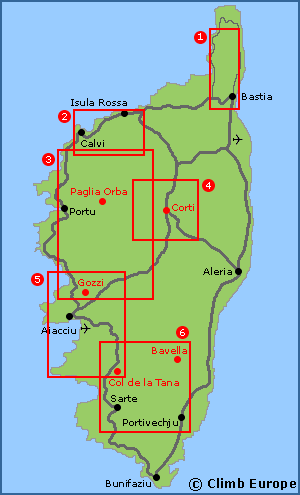
(5) Rock climbing around Aiacciu. At Gozzi there is perfect balance of mountains and the cliffs, with a great diversity of climbing styles. The red granite is fully bolted with a mixture of single-pitch routes to multi-pitch routes up to 300m long - the longest bolted routes on the island. There are other granite crags around this area, all of which are bolted giving both single and multi-pitch routes (up to 5 pitches long).
To the south of Aiacciu is the Taravu valley with some great limestone rock. There are numerous crags offering single pitch sport routes, plus bolted multi-pitch routes at Col de la Tana, and bouldering at Valdu di Saltu.
(6) Rock climbing at Bavella and southern Corsica. Here there is a mixture of limestone and granite rock. The limestone crags tend to be at a lower altitude and are single pitch. The granite crags are concentrated around Bavella, which is high up in the mountains and a vast area. Here there are single and multi-pitch (up to 3 pitches long) bolted sport routes. However Bavella is best known for its long multi-pitch traditional routes up to 350m long that provide a great overall adventure. Find out more…
Bouldering in Corsica
Corsica is a great place for bouldering with many established areas in the same places as the sports climbing areas. The bouldering in Corsica is generally on excellent granite rock with a wide range of grades to choose from. The 2 main bouldering areas on Corsica are; around Calvi in the northwest of the island; and the Gorges de la Restonica near Corti (Corte).
What rock climbing guidebooks are available for Corsica?
The current rock climbing guidebook that covers the sport climbing in Corsica is called "Falaises de Corse". This guidebook was re-published in 2023, and it details 87 crags across Corsica including the popular rock climbing areas of Restonica, Gozzi and Bavella. It covers over 2,700 sport routes across a wide range of grades, plus some trad routes. Buy this guidebook from our shop.
The “Grandes voies de Corse” guidebook describes 155 of the best multi-pitch trad and sport routes in northwest of Corsica, and central Corsica. It includes the limestone areas around Corti, the granite areas north of Aiacciu, and the Gorges de la Restonica near Corti. Buy this guidebook from our shop.
The “Bavella rock climbing guidebook” is a comprehensive guidebook covering the multi-pitch routes at Bavella. Buy this guidebook from our shop.
When is the best time to go rock climbing in Corsica?
The best months to go rock climbing in Corsica are from spring to early June and then September until the end of autumn. In main summer months of July and August will be just too hot and very busy.
Corsica is also an excellent place to go hill walking, trekking and mountaineering with many long distance paths and trails. Discover the best long distance paths and trails in Corsica such as the famous GR20 route. Find out more…